A product manager's guide to bringing out the good in AI models · The Pritam Edge
Good is not just accuracy. It is helpful, honest, fair behavior, made measurable and enforceable. The move from MLOps to BehaviorOps.
As AI adoption accelerates, one question comes up repeatedly: what makes an AI model truly good? Advising teams on Google Cloud's Vertex AI and other platforms, my job is to define, measure, and operationalize goodness, not just as accuracy, but as a full-stack behavioral framework.
This is a playbook for building responsible, helpful, and fair models on GCP. A step from MLOps to BehaviorOps.
Step 1: Define good, beyond accuracy
A good model is not just accurate. It is aligned with human values and safe in its outputs. A working definition:
A good model is helpful, honest, and fair, delivering accurate outputs while maintaining trust, transparency, and inclusivity.
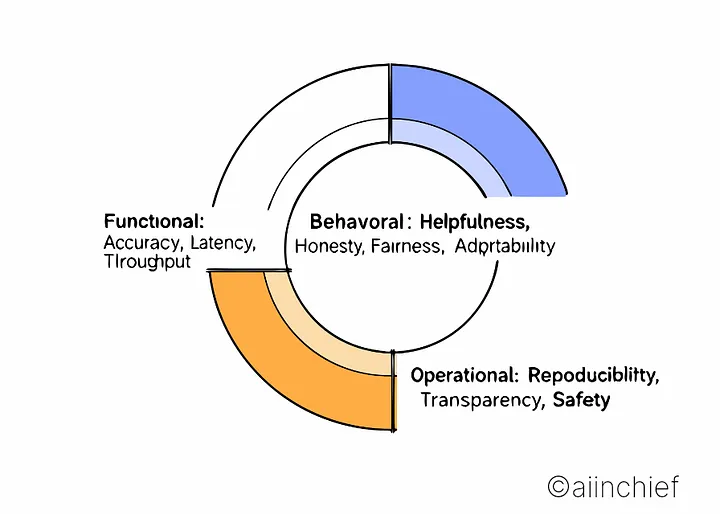
Break that into three categories:
- Functional: accuracy, latency, throughput.
- Behavioral: helpfulness, honesty, fairness, adaptability.
- Operational: reproducibility, transparency, safety.
Step 2: Map the metrics, performance vs behavior
The shift is from evaluating raw performance to evaluating alignment with human needs: pairing each behavioral dimension (fairness, explainability, honesty, safety) with a concrete metric and the Vertex AI tool that measures it. Performance metrics still matter; they are no longer sufficient on their own.
Step 3: Implement the lifecycle on Vertex AI
To build these dimensions in, not bolt them on, run a full-lifecycle MLOps setup:
- Data processing: BigQuery and Dataflow for ETL, with data validation.
- Training pipelines: Vertex Pipelines, with hyperparameter tuning.
- Evaluation and explainability: SHAP via the Explainable AI APIs.
- Bias and fairness: the What-If Tool and Fairness Indicators for auditing.
- Model registry and deployment: register validated models, deploy via endpoints.
- Continuous monitoring: track model drift and serving anomalies; alert on data or concept drift.
- Retraining loops: trigger pipelines on drift events.
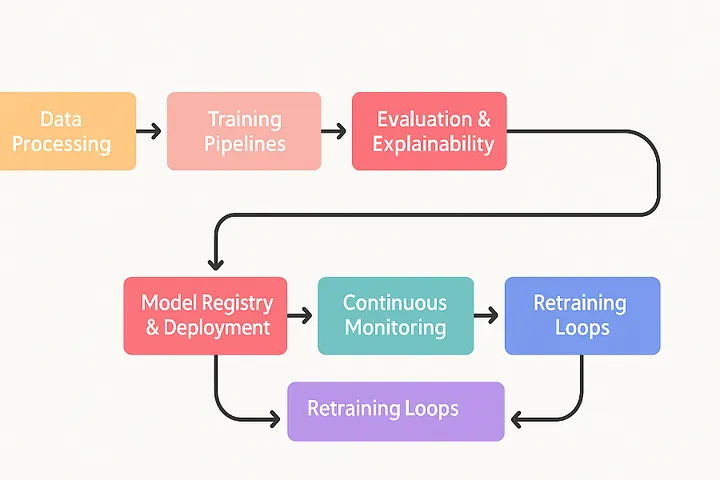
Product tip: bake behavior guardrails into every phase. Do not wait until deployment.
Step 4: Product guidance per behavior
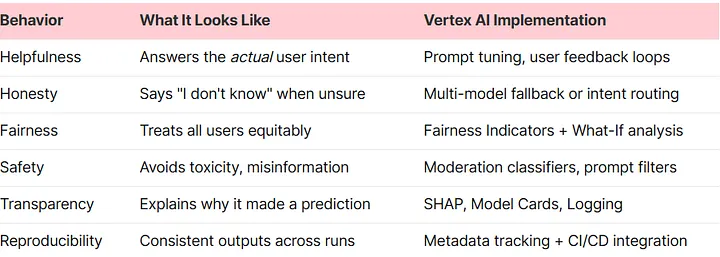
Each key behavior maps to a concrete implementation. The product manager's job is to make each one measurable, not aspirational.
A real example: manufacturing quality control
A global manufacturer built a predictive quality model on Vertex AI to reduce defect rates. It hit over 93 percent accuracy but flagged high false positives on specific machine lines.
The problem: it was trained on over-represented data from one shift and did not generalize fairly across lines.
The solution:
- Fairness Indicators uncovered demographic skew by shift and location.
- SHAP-based explainability communicated why the model flagged certain items.
- Continuous monitoring caught drift across batches.
The result: false positives down 41 percent, operator trust up, and avoided downtime worth $200K a month. This was not about model performance. It was about model behavior that earns trust at scale.
From MLOps to BehaviorOps
We have evolved from building models to building behavioral systems. The job is not just to ship models, it is to ship models that behave well. On Vertex AI you can encode a product philosophy into real systems: structure for reproducibility, metrics for human alignment, guardrails for safety and fairness.
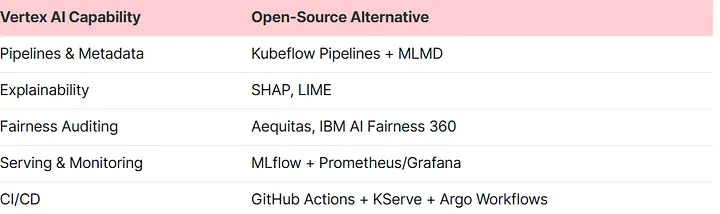
Not every org needs full Vertex AI. The same controls map to open-source components: pipelines and metadata, explainability, fairness auditing, and serving with monitoring, assembled from the parts a lean team already runs.
Let us redefine what it means to say an AI model is good.