The Missing First Step in AI Transformation · The Pritam Edge
Most AI failures aren’t technical. They’re strategic. And the most common reason? Skipping structured discovery.
This is Post 1 of the 4-part AI Blueprint Series - your execution blueprint:
- You are here → Discovery Done Right
- Design Thinking for AI-Native Systems →
- AI ProcessOps: The New Org Layer →
- From Strategy to Stack →
The Problem: GenAI is Booming - But Results Aren’t
Organizations are racing to adopt Generative AI - launching pilots, buying LLM licenses, and hiring prompt engineers.Yet, 70% of AI initiatives stall after the pilot phase. They either fail to scale, don’t align with core business outcomes, or run into organizational resistance.
Why?
Because they skipped the most important step: Discovery.
Why Discovery Is the Foundation for AI ROI
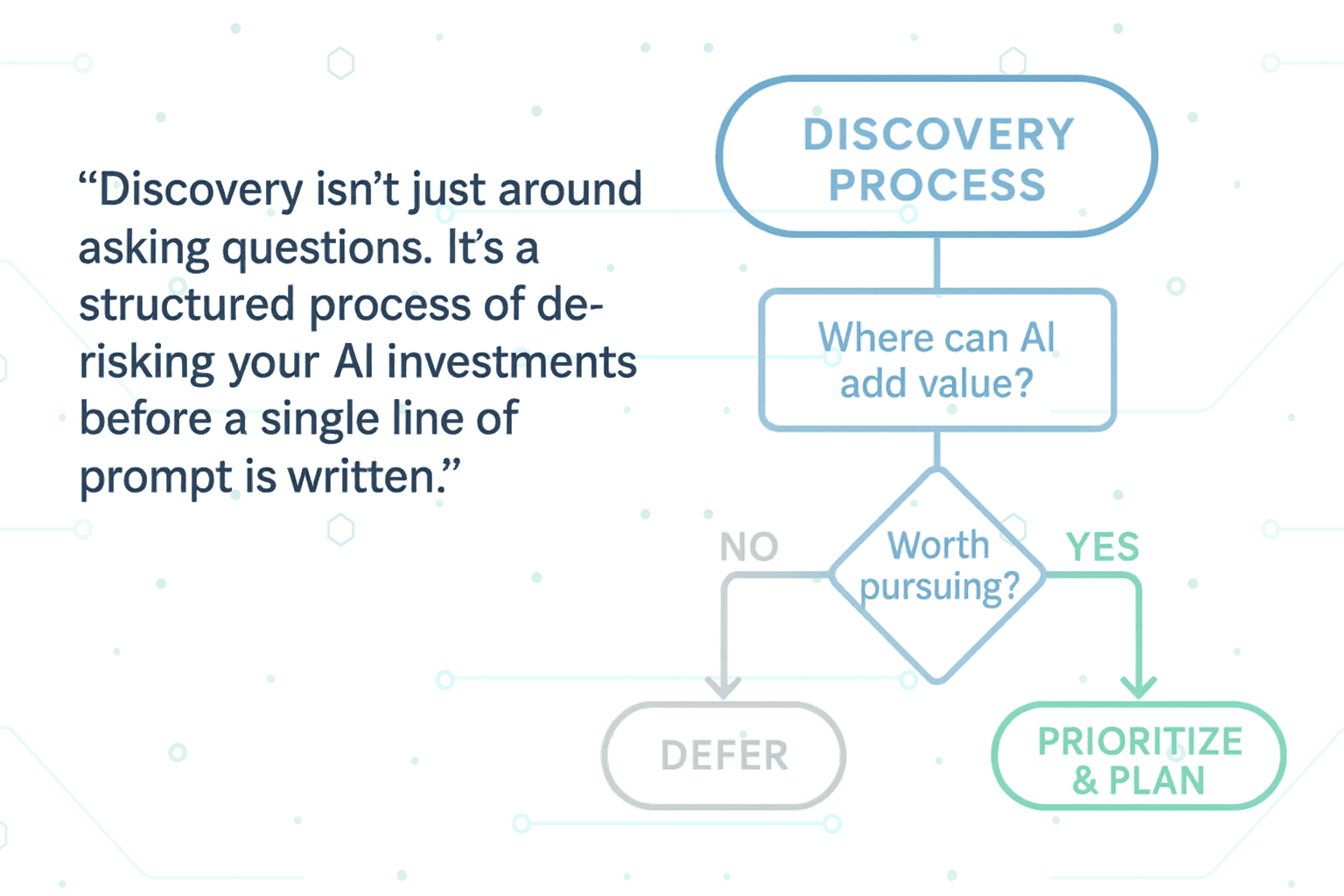
Discovery isn’t just a kickoff meeting. It’s a structured process of de-risking your AI investments before a single line of prompt is written.
Discovery Done Right
Most AI failures aren’t technical. They’re strategic. And the most common reason? Skipping structured discovery.
It answers critical questions:
- Where can AI actually create value?
- How should GenAI augment - not replace - human workflows?
- What infrastructure and governance must be in place?
AIC’s approach to discovery ensures you're solving the right problems, for the right users, using the right stack.
The AI In Chief Discovery Framework
We structure discovery around three pillars that link strategy with systems:
1. Process
Map how work gets done today - across people, tools, and content. Surface delays, handoffs, and judgment points.
2. People
Identify human roles across every step. Who decides, who approves, who drafts, who acts? This shapes HITL (Human-in-the-loop) flows.
3. Priorities
Not all ideas are equal. We score use cases based on:
- Business impact (cost savings, revenue enablement, speed)
- Technical feasibility (data, workflow maturity)
- Organizational readiness (culture, risk, change appetite)
Together, these become the foundation of your AI Blueprint (more on that below).
Tactical Frameworks You Can Use
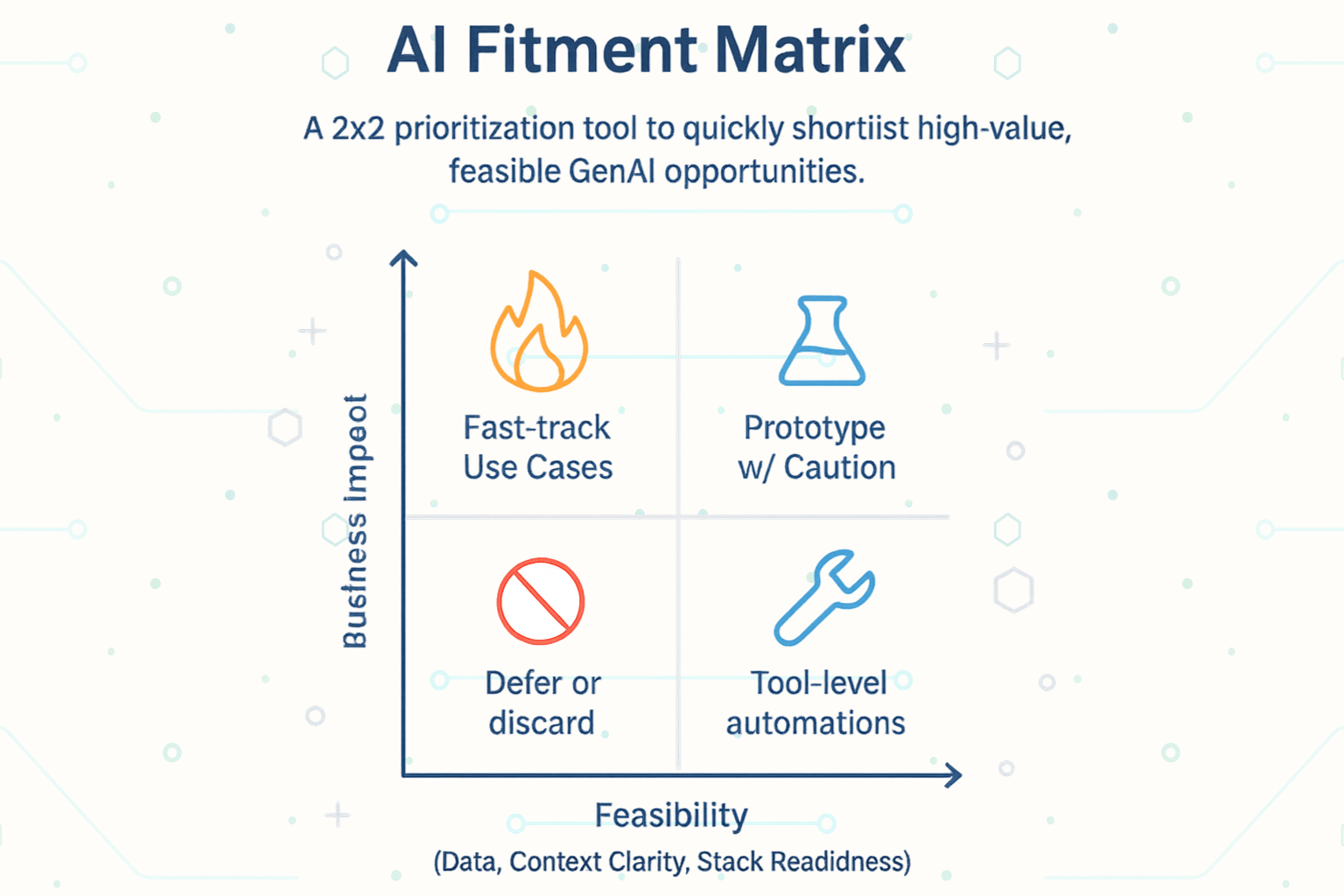
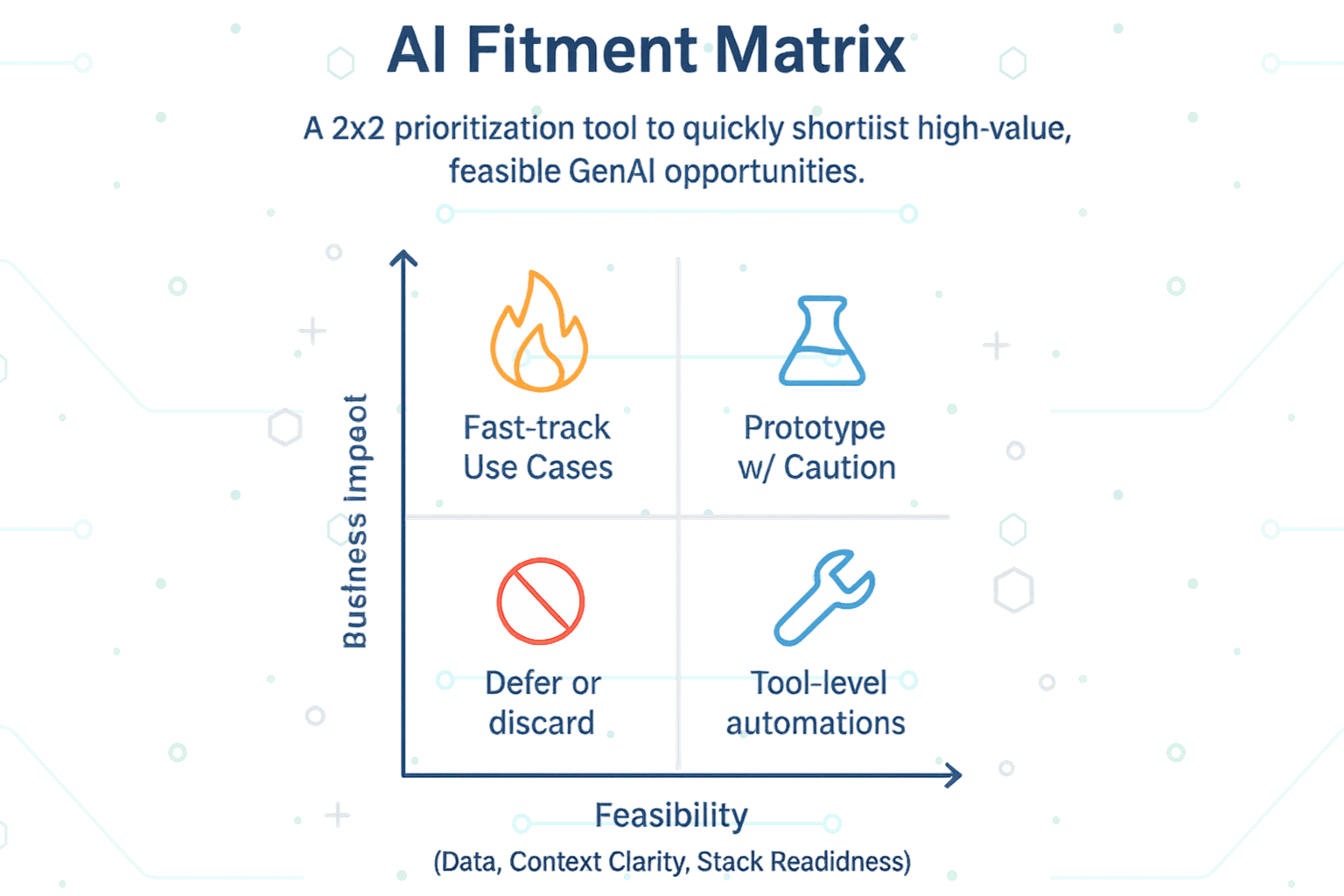
AI Fitment Matrix
A 2x2 prioritization tool to quickly shortlist high-value, feasible GenAI opportunities.
Axes:
- X-Axis: Feasibility (Data, Context Clarity, Stack Readiness)
- Y-Axis: Business Impact (Efficiency, Revenue, Customer Experience)
Quadrants:
- High Impact, High Feasibility → Fast-track Use Cases
- High Impact, Low Feasibility → Prototype w/ Caution
- Low Impact, High Feasibility → Tool-level automations
- Low Impact, Low Feasibility → Defer or discard
How to Use:
- Run post-it or sticky board exercises in discovery workshops
- Have business + tech leads vote independently, then align
- Use output to pick your 3-5 “Quick Win” and “Strategic Build” use cases
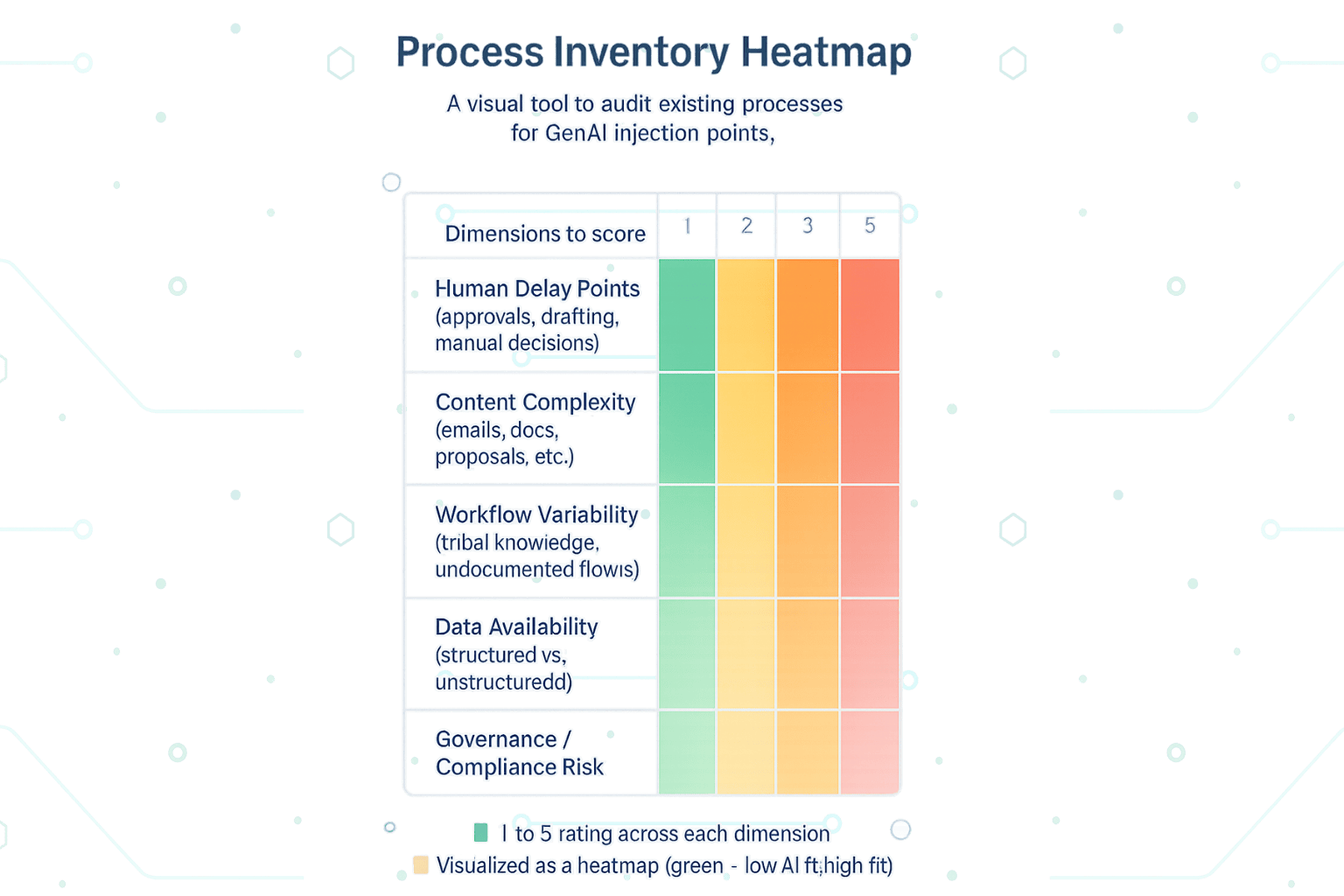
Process Inventory Heatmap
A visual tool to audit existing processes for GenAI injection points.
Dimensions to Score:
- Human Delay Points (approvals, drafting, manual decisions)
- Content Complexity (emails, docs, proposals, etc.)
- Workflow Variability (tribal knowledge, undocumented flows)
- Data Availability (structured vs. unstructured)
- Governance / Compliance Risk
Scoring Scale:
- 1 to 5 rating across each dimension
- Visualized as a heatmap (green = low AI fit, red = high fit)
How to Use:
- Inventory 20-50 processes per business function
- Score each process via team interviews or async surveys
- Highlight top 5-10 candidates for deeper canvas mapping
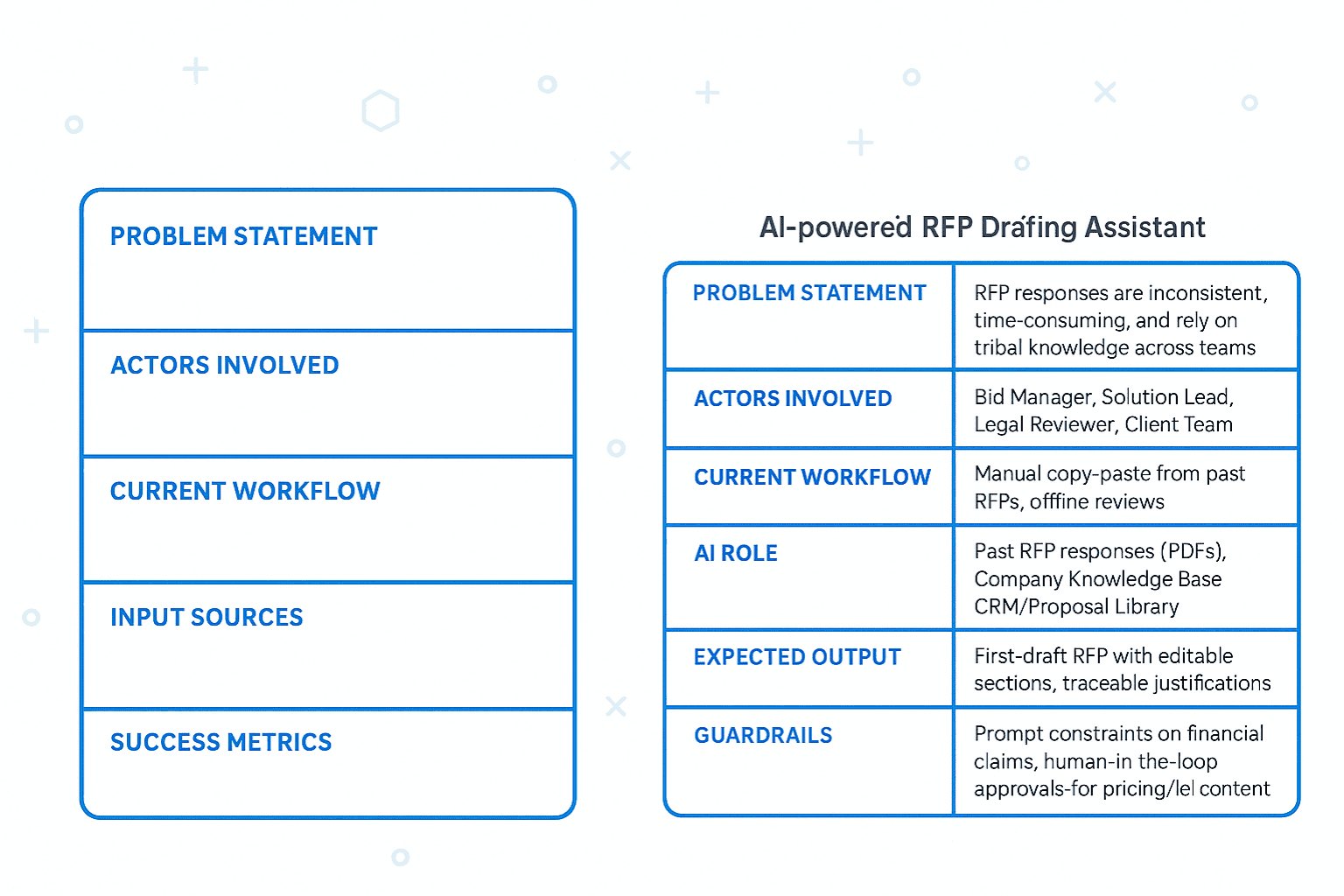
Use Case Canvas
A one-page AI design artifact to validate each shortlisted idea.
Template Fields:
- Problem Statement
- Actors Involved (Users, Reviewers, Customers)
- Current Workflow
- AI Role (e.g., Generate, Classify, Recommend, Summarize)
- Input Sources (Structured/Unstructured data, APIs)
- Expected Output (Content, Insights, Recommendations)
- Success Metrics (Time saved, accuracy, conversion)
- Guardrails (Prompt constraints, human review points)
How to Use:
- Fill one canvas per high-priority use case
- Use as a handoff to Design & PromptOps teams
- Revisit post-deployment for outcome validation
The AI Blueprint: More Than a Map
Our AI Blueprint isn’t a static document - it’s a living architecture for transformation.
It covers:
1. AI-Native Process Design
Processes are no longer rigid. With GenAI and agents, flows become:
- Intent-based rather than step-based
- Context-aware rather than form-driven
- Dynamic with HITL checkpoints and override options
Your blueprint maps these flows visually - using Trigger Trees, Decision Nodes, and Agent Insertion Points.
2. Human-in-the-Loop (HITL) Design
We don’t remove humans - we redesign their roles:
- Review → Curate
- Approve → Coach
- Perform → Prompt
HITL design is embedded into the blueprint with roles, guardrails, and escalation logic.
3. AI-Native Infrastructure Alignment
Your stack should enable:
- Fast access to context (via RAG / vector DBs)
- Prompt chaining, orchestration, and fallback logic
- Policy-enforced guardrails and observability
Your blueprint will highlight:
- Suggested LLM architecture
- PromptOps structure
- Native integration points into your current apps (email, CRM, RFP tools, etc.)
What Bad vs. Good Discovery Looks Like
| Bad Discovery | Good Discovery | |
|---|---|---|
| Approach | Top-down idea or exec mandate | Ground-up analysis of real process friction |
| Use Case Selection | Follows market hype | Aligned to internal priorities & AI-fit matrix |
| Outcome | POC that can't scale | Scalable design that feeds into PromptOps |
| User Buy-in | Low - feels like IT project | High - co-created with real business users |
| Stack Alignment | Tool first, process second | Process first, stack comes later |
What You’ll Walk Away With
AIC-led discovery gives you:
A ranked use case backlog
Process heatmaps and canvas docs
PromptOps readiness signals
Stakeholder alignment
Stack design requirements
Blueprint-ready handoff for design & deployment
This is the real starting point for your AI-native transformation.
Ready to Discover the Right Way?
Let’s co-create your GenAI roadmap with our proven Discovery methodology.
[Book a Discovery Workshop →]
[Download Our Use Case Canvas →]
[Explore the Full AI ProcessOps Blueprint →]
Part of the AI Blueprint Series: From Discovery to Deployment