SRE for agentic systems · The Pritam Edge
The discipline that kept distributed systems reliable is the one that will keep agent fleets reliable. SLOs, error budgets, and blameless postmortems, pointed at the harness.
Maya runs reliability for a team that just put its first agent into production. At 2am her phone lights up: the agent has been retrying the same failed action for forty minutes, quietly burning tokens and confidence. She does not reach for a model benchmark. She reaches for the runbook, the dashboards, the error budget. And somewhere between the third alert and the first coffee, she realizes something: she has seen this shape before. This is not a new problem. It is an old discipline pointed at a new machine.
We spent fifteen years learning how to run large distributed systems that fail in unpredictable ways. We called it Site Reliability Engineering. Agentic systems are large distributed systems that fail in unpredictable ways. The vocabulary transfers almost intact. Most teams have not noticed yet, because they are still arguing about which model to use. Let me weigh in across three threads.
1. Measure the loop, not the model
The first SRE lesson is that reliability is a number, not a vibe. You define a Service Level Objective, you instrument it, and you hold the system to it. The trap with agents is picking the wrong number. Model accuracy on a benchmark tells you almost nothing about whether the system behaves in production.
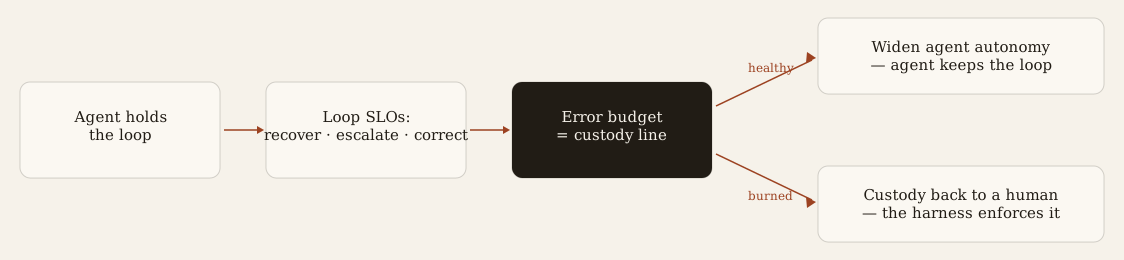
The SLOs that matter for an agent are loop SLOs. Recovery rate: when the agent is wrong, how often does it correct itself without a human. Escalation rate: how often it hands back to a person, and whether that number is trending the right way. Time to correct: how long a bad state persists before the loop closes. None of these live in the model. They live in the harness. You can swap the model and watch these numbers barely move, which is the whole point.
2. The error budget is the custody line
Here is the idea I keep coming back to. In SRE, an error budget is permission to be imperfect: if your target is 99.9 percent, you have 0.1 percent to spend, and you spend it deliberately. For agents, the error budget is not just a tolerance. It is where control changes hands.
An agent's error budget is the custody line. Below it, the agent holds the loop and acts on its own. At it, custody transfers back to a human. Reliability engineering for agents is the practice of drawing that line on purpose, per task, and moving it with evidence instead of nerve. Place the human where the cost of being wrong is highest, not where the work is easiest to review. When the error budget is healthy, you widen the agent's autonomy. When you burn it, you pull custody back. The harness is what enforces that transfer, which is why the harness, not the model, is the asset you actually own.
3. Break it on purpose, then learn from the break
The two most underused SRE practices map cleanly onto agents.
Fault injection. We learned not to trust a distributed system until we had failed it deliberately: killed nodes, cut networks, watched recovery. Do the same to an agent. Feed it a broken tool, a contradictory instruction, a timeout, a hostile input. An agent you have never seen fail is an agent you do not understand. Chaos is cheaper than a production incident.
Blameless postmortems. In SRE the postmortem is sacred because the incident is data, not shame. For agents this compounds beautifully: every human correction, every escalation, every recovered failure is training data for the harness, not a one-off patch. The team that treats corrections as harness improvements builds a system that gets more reliable while its competitors keep waiting for the next model release.
The discipline was never really about servers
The uncomfortable truth for anyone who thought SRE was a Web2 job title: it was never about servers. It was about running systems whose behavior you cannot fully predict, with rigor instead of hope. That is exactly the job that agentic AI just created at ten times the scale.
So the teams that will operate agent fleets reliably are not the teams with the best model access. They are the teams that already know what an error budget is, and are now brave enough to point it at an agent. Extend the power of the LLMs; contain the abandon of the agents. The number that tells you which side of that line you are on is a loop SLO, and the thing that holds the line is the harness.
Buy the model. Build the harness. Measure the loop.